In a world obsessed with oil routes, gas pipelines, and energy geopolitics, something quieter—yet potentially far more transformative—just happened on the southeastern coast of India.
At Kalpakkam, a nuclear reactor didn’t just switch on. It crossed a threshold.
And that threshold may shape the future of energy.
A Moment Called “Criticality”
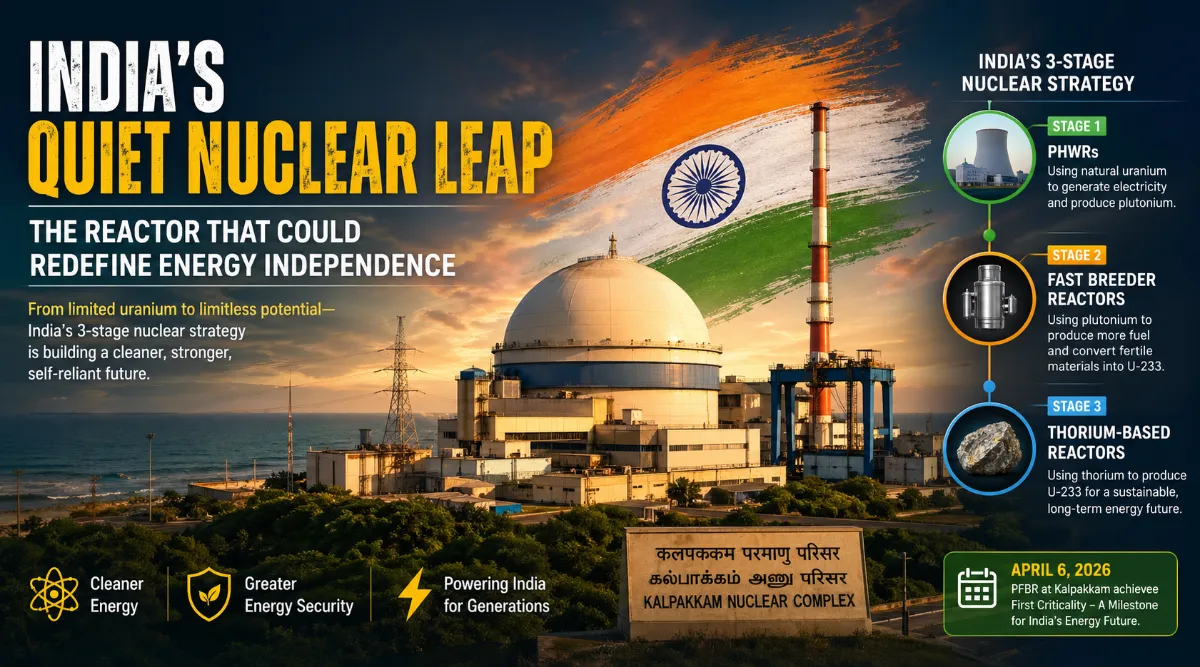
On April 6, 2026, India’s Prototype Fast Breeder Reactor (PFBR) achieved what scientists call first criticality—the point where a nuclear reactor sustains a controlled chain reaction on its own.
This isn’t full power generation yet. It’s something more fundamental.
It means the reactor is alive.
This 500 MW reactor, built at the Kalpakkam Nuclear Complex, marks India’s formal transition into the second stage of a decades-long nuclear strategy first envisioned in the 1950s.
And that strategy is unlike anything most countries are attempting.
The Vision That Started It All
India’s nuclear roadmap was designed by physicist Homi J. Bhabha, who saw a problem early:
- India had very limited uranium reserves
- But it possessed vast thorium deposits, especially along its coasts
Thorium, however, cannot be used directly as fuel.
So Bhabha proposed a long-term plan—one that would take decades to unfold.
The Three-Stage Nuclear Strategy
India’s nuclear program is not a single leap—it’s a carefully constructed staircase.
Stage 1: Build the Foundation
India began with conventional reactors using natural uranium. These reactors generated electricity and, crucially, produced plutonium as a byproduct.
This plutonium would become the key to the next stage.
Stage 2: The Breeder Revolution
This is where Kalpakkam comes in.
Fast breeder reactors like the PFBR do something remarkable:
They produce more nuclear fuel than they consume.
Using a mix of uranium and plutonium (MOX fuel), the reactor generates energy while also converting fertile materials into new fuel.
This “breeding” process is the bridge to something bigger.
It allows India to stretch its limited uranium resources far beyond conventional limits—and begin preparing for thorium use.
Stage 3: The Thorium Future
The final goal is ambitious:
- Use thorium to produce Uranium-233
- Build reactors powered primarily by this new fuel
- Achieve long-term energy independence using domestic resources
India holds around a quarter of the world’s thorium reserves, making this path uniquely strategic.
Why This Reactor Matters
The PFBR is not just another power plant. It’s a proof of concept.
1. It Extends Fuel Life
Instead of consuming fuel, breeder reactors generate more of it—dramatically improving efficiency.
2. It Reduces Dependence
India has historically relied on imported uranium. This technology offers a pathway to reduce that dependency.
3. It Unlocks Thorium
The reactor is designed to eventually convert thorium into Uranium-233, paving the way for the final stage of the program.
4. It Places India in an Elite Club
Only a handful of countries have successfully developed fast breeder reactors at this scale.
India is now among them.
Not a Shortcut—A Long Game
Despite the excitement, this is not an overnight transformation.
- The PFBR has just reached criticality, not full commercial operation
- Thorium-based reactors are still under development
- Scaling this technology will take years, possibly decades
But that’s the nature of nuclear science: slow, complex, and profoundly strategic.
The Bigger Picture
Energy independence is one of the defining challenges of the 21st century.
Most nations are still:
- Competing for fossil fuels
- Navigating geopolitical chokepoints
- Racing toward renewables with uneven results
India is doing something different.
It is investing in a system that, if fully realized, could provide stable, long-term, low-carbon energy using its own natural resources.
Some estimates suggest such a system could support power generation for centuries, though that remains a long-term potential rather than an immediate reality.
A Quiet Shift with Global Implications
There are no dramatic headlines. No sudden disruptions.
Just a reactor, reaching criticality on a coastal site.
But behind that moment lies decades of planning—and a future that could gradually reshape how energy is produced, stored, and controlled.
India hasn’t solved the energy puzzle yet.
But with Kalpakkam, it has moved one step closer to rewriting it.