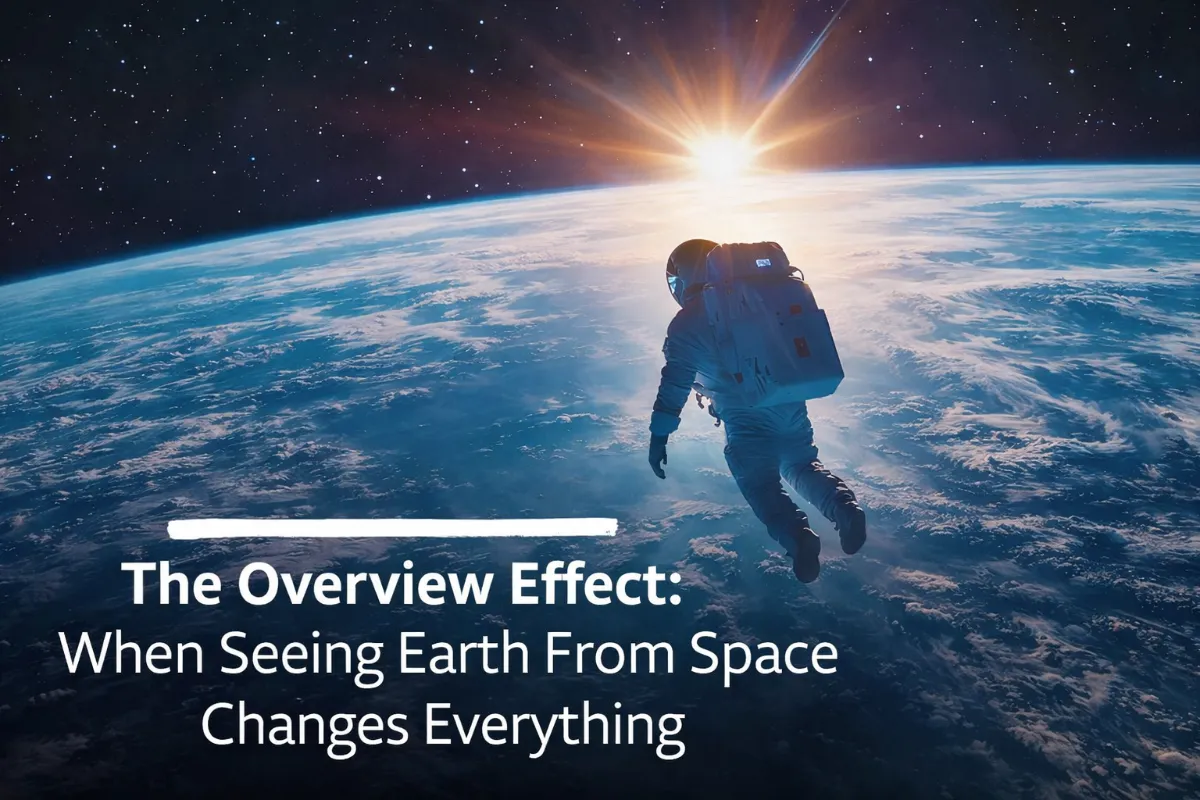
There is a moment astronauts often struggle to describe. It happens quietly, sometimes unexpectedly, as they float near a window and look back at Earth. From that distance, our planet no longer resembles the divided, chaotic world we know from the ground. It appears whole. Fragile. Alive. And for many who witness it, that single view permanently reshapes how they understand humanity, conflict, and their own place in the universe.
This psychological and emotional shift is known as the Overview Effect — a profound change in awareness reported by astronauts who have seen Earth from space.
A Planet Without Borders
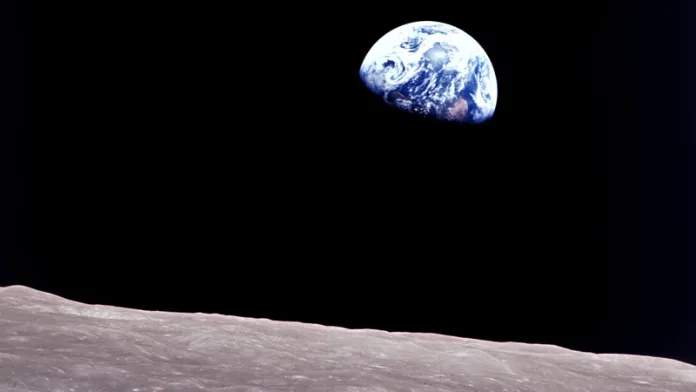
From orbit, borders do not exist. There are no lines separating nations, no walls dividing people, no visible signs of ideology or power. What stands out instead is a thin, glowing atmosphere wrapped around a small blue sphere, suspended in darkness.
Astronauts often say that from space, Earth looks more like a living organism than a collection of countries. Oceans connect continents seamlessly. Clouds drift freely across political boundaries. The idea that humanity is divided into “us” and “them” suddenly feels artificial — even absurd.
What once seemed important on Earth — territorial disputes, national rivalries, political dominance — shrinks into insignificance against the vastness of space.
A Shift That Is Emotional, Not Just Intellectual
The Overview Effect is not simply a new way of thinking. It is a deeply emotional experience.
Astronauts frequently describe overwhelming feelings of awe, humility, and connection. Some speak of joy. Others admit to moments of sadness or grief, realizing how carelessly humanity treats its only home. A few describe it in spiritual terms, as if the universe briefly pulled back a curtain and revealed a larger truth.
Seeing Earth from space doesn’t make problems disappear — it reframes them. Conflict becomes smaller. Cooperation feels essential. The survival of the planet no longer seems abstract or theoretical; it feels personal.
The Fragility of Home
One of the most striking realizations astronauts report is how thin Earth’s protection really is. The atmosphere — the layer that allows life to exist — appears as a delicate veil. From space, it is painfully clear how little separates life from lifelessness.
There is no visible backup planet.
No alternative refuge.
No second Earth waiting nearby.
That realization often brings a renewed sense of responsibility. Climate change, pollution, deforestation, and war no longer feel like distant policy debates. They feel like direct threats to a fragile system that sustains every living thing.
Why Most of Us Will Never Experience It — and Why That Matters
Only a tiny fraction of humanity will ever see Earth from orbit. The Overview Effect, by definition, belongs to a privileged few.
But its lesson does not have to.
The core message is simple: perspective changes behavior. When people perceive themselves as part of something larger, empathy increases. When divisions fade, cooperation becomes easier. When Earth is seen as a shared home rather than contested territory, protecting it becomes a collective duty.
That insight matters now more than ever, in a world fractured by political polarization, environmental crises, and growing inequality.
Finding a Piece of the Overview Effect on Earth
You don’t need to be an astronaut to experience a shift in perspective.
Moments of awe — standing beneath a vast night sky, watching the ocean stretch endlessly toward the horizon, or witnessing nature’s scale and power — can momentarily dissolve ego and remind us of our place in the larger story.
These experiences don’t replicate spaceflight, but they can echo its impact. They remind us that life is interconnected, that humanity shares more than it divides, and that our planet is both resilient and vulnerable.
A Lesson Worth Carrying Forward
The Overview Effect does not offer easy solutions to the world’s problems. It does something quieter — and perhaps more important. It changes how people care.
When Earth is seen as one system, protecting it feels less like sacrifice and more like self-preservation. When humanity is viewed as one family, compassion becomes logical rather than idealistic.
Perhaps the most powerful legacy of space exploration is not technological advancement, but this simple realization:
We are all passengers on the same fragile world, drifting together through the vastness of space.
And once you truly see that, it becomes impossible to look at Earth — or each other — the same way again.