Football has always been different.
For 90 minutes, the game flows almost uninterrupted. Momentum builds. Pressure mounts. Fatigue becomes part of the contest. Unlike American football, basketball, or baseball, there are no scheduled timeouts for coaches to gather players and redraw tactics. There are no commercial breaks every few minutes. The game belongs to the players until halftime.
That is why one of the biggest stories of the 2026 FIFA World Cup is not a wonder goal, a shocking upset, or a controversial refereeing decision.
It is a three-minute pause.
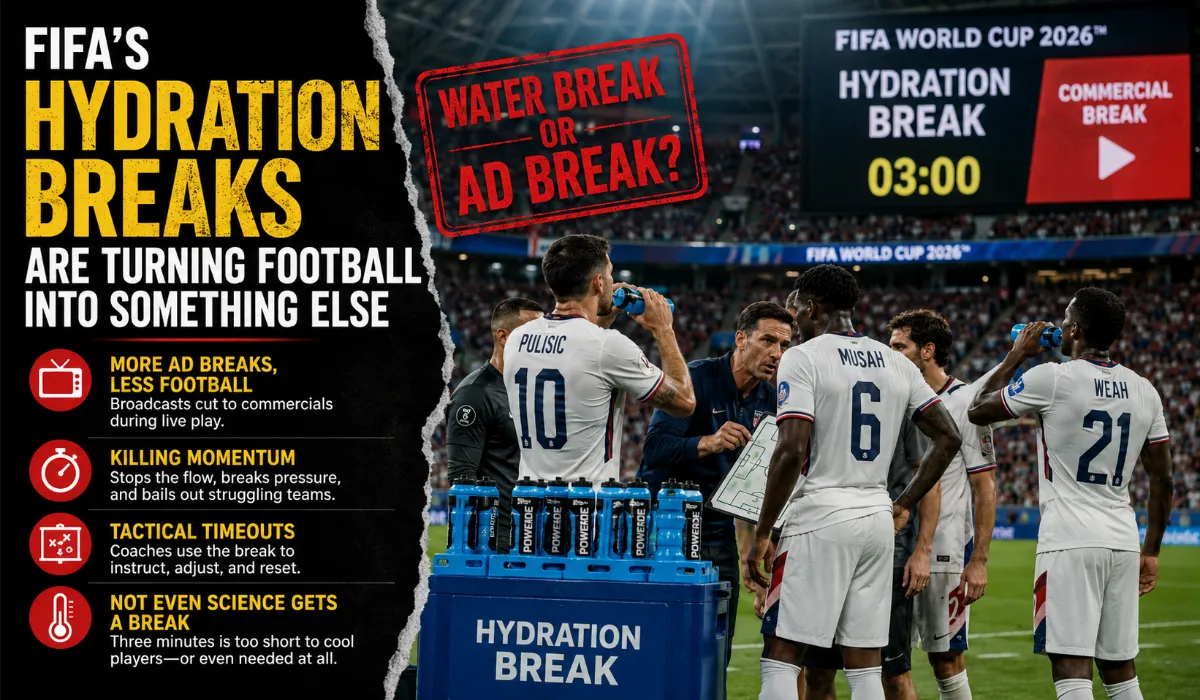
FIFA’s decision to introduce mandatory hydration breaks in every World Cup match has sparked a growing backlash from players, coaches, pundits, and supporters. Officially, the breaks are intended to protect players from the summer heat across North America. Unofficially, many fans believe they represent something else entirely: football’s gradual transformation into a television product.
The criticism has become so widespread that the debate is no longer really about hydration.
It is about momentum.
It is about commercialization.
And it is about what kind of sport football wants to be.
Football’s First Real Timeout
Under FIFA’s new policy, every World Cup match includes a mandatory hydration break around the 22nd minute of each half.
The rule applies universally across all 104 matches of the tournament.
That means a match played under intense Mexican summer heat receives the same interruption as a match played in mild temperatures or inside a climate-controlled stadium.
For many fans, the immediate reaction was simple.
Why?
Football has used cooling breaks before, but only under exceptional weather conditions. What makes the 2026 World Cup different is that the breaks are now mandatory regardless of circumstances.
The result is effectively the creation of football’s first scheduled timeout.
And that has many people worried.
The Beautiful Game Was Never Built Around Commercial Breaks
The most common criticism directed at FIFA is also the most uncomfortable one.
Many supporters believe the breaks exist as much for broadcasters as they do for players.
Television networks have quickly embraced the interruptions, often cutting directly to commercials while players gather around the touchline. For viewers watching from home, the experience can feel remarkably similar to the advertising breaks common in American sports.
That comparison alone has been enough to alarm many football supporters.
For decades, football has prided itself on being the world’s most fluid major sport. A match can swing dramatically within seconds. A counterattack can emerge from nowhere. Moments of magic arrive unexpectedly.
Advertising breaks interrupt that experience.
Critics argue that FIFA is introducing television-friendly stoppages into a sport that never needed them.
The controversy intensified during Mexico’s opening match against South Africa when reports emerged that officials had to delay restarting play because a broadcaster was still showing advertisements.
The image was difficult to ignore.
A football match waiting for commercials to finish before play could resume.
For many fans, that moment perfectly captured their fears about the direction of the sport.
The concern is not simply that broadcasters are showing advertisements.
The concern is that football itself may be starting to adapt to them.
Momentum Is One of Football’s Greatest Weapons
Football is unlike most sports because momentum cannot be paused.
When a team dominates possession, pins its opponent deep inside their own half, and begins creating chance after chance, there is traditionally no escape route.
The defending team must survive.
That is part of what makes the sport compelling.
Hydration breaks change that equation.
Suddenly, the team under pressure receives a chance to recover physically and mentally. Players can catch their breath. Defenders can regroup. Coaches can reorganize their structure.
Meanwhile, the attacking side loses the rhythm it worked so hard to establish.
Several coaches and analysts have described the new stoppages as “momentum breaks” rather than hydration breaks.
The phrase resonates because it captures the central complaint.
Football’s flow is not merely being interrupted.
It is being altered.
The team earning an advantage through superior play can find its momentum frozen, while the struggling side is handed an opportunity to reset.
That changes the competitive balance of matches.
And many people believe it changes football itself.
From Water Break to Coaching Break
Perhaps the strongest evidence that something has changed can be found on the touchline.
Managers are not treating these interruptions as simple hydration opportunities.
They are treating them as tactical meetings.
Coaches gather players around tactic boards. Formations are adjusted. Pressing triggers are discussed. New instructions are delivered.
Belgium coach Rudi Garcia openly acknowledged that he views the stoppages as coaching breaks.
That honesty only fueled criticism.
Football has traditionally rewarded players who can solve problems in real time. Captains were expected to organize teammates. Midfielders were expected to recognize tactical shifts. Teams adapted through intelligence and experience.
Mandatory breaks introduce a different dynamic.
The manager gains more influence.
The players gain less responsibility.
And the sport moves closer to a timeout-driven model.
For some supporters, that represents a fundamental shift in football culture.
The Strange Case of Indoor Hydration Breaks
The backlash has become particularly intense when breaks occur in conditions that hardly seem dangerous.
During England’s match against Croatia, spectators reportedly booed a hydration break inside a modern stadium equipped with climate control.
The reaction was understandable.
If the environment is comfortable, what exactly is the cooling break cooling?
FIFA argues that universal implementation ensures fairness and consistency.
Critics argue that common sense should prevail.
Spain coach Luis de la Fuente questioned the need for mandatory interruptions in mild conditions, echoing a concern shared by many fans.
Player safety is a serious issue.
But applying the same solution regardless of circumstances has created situations that appear absurd to spectators.
The more these moments occur, the harder it becomes for FIFA to convince critics that the policy is purely about heat management.
Even Scientists Think the Rule Makes Little Sense
Ironically, some of the harshest criticism comes not from football traditionalists but from sports scientists.
Their complaint is completely different.
They argue that the breaks are too short.
Experts studying heat-related illness have noted that three minutes is often insufficient to meaningfully lower an athlete’s core body temperature during extreme heat.
In truly dangerous conditions, effective cooling and rehydration may require five or six minutes or even longer.
That creates a strange contradiction.
Football fans complain the breaks are too disruptive.
Scientists complain they are too brief.
The result is a policy that satisfies neither side.
It interrupts matches enough to alter momentum but may not be long enough to achieve the medical benefits being used to justify its existence.
Is FIFA Protecting Players or Protecting Revenue?
Few people dispute that player welfare matters.
Modern football is faster, more demanding, and physically more intense than ever before. Protecting athletes from dangerous heat should be a priority.
The problem is perception.
Every time a broadcast cuts to advertisements during a hydration break, suspicion grows.
Every time a coach unfolds a tactical board, suspicion grows.
Every time a match pauses in comfortable temperatures, suspicion grows.
The debate is no longer about water bottles.
It is about trust.
Fans want to believe the breaks exist solely for player safety.
But the way they are being implemented has created an entirely different impression.
Many supporters see not a cooling break, but a commercial break.
Not a welfare measure, but a television product.
Not a necessary evolution of football, but an unnecessary interruption to the world’s most popular sport.
The Real Danger
The greatest danger is not that players stop for three minutes.
The greatest danger is that people get used to it.
Football’s identity has always been tied to its continuous flow. Once scheduled interruptions become normal, more interruptions become easier to justify.
Today it is a hydration break.
Tomorrow it could be something else.
That is why this debate matters.
The controversy surrounding FIFA’s hydration breaks is ultimately about more than heat, water, or even advertising.
It is about preserving the essence of football itself.
And judging by the reaction across the World Cup, many supporters believe that essence is already under threat.