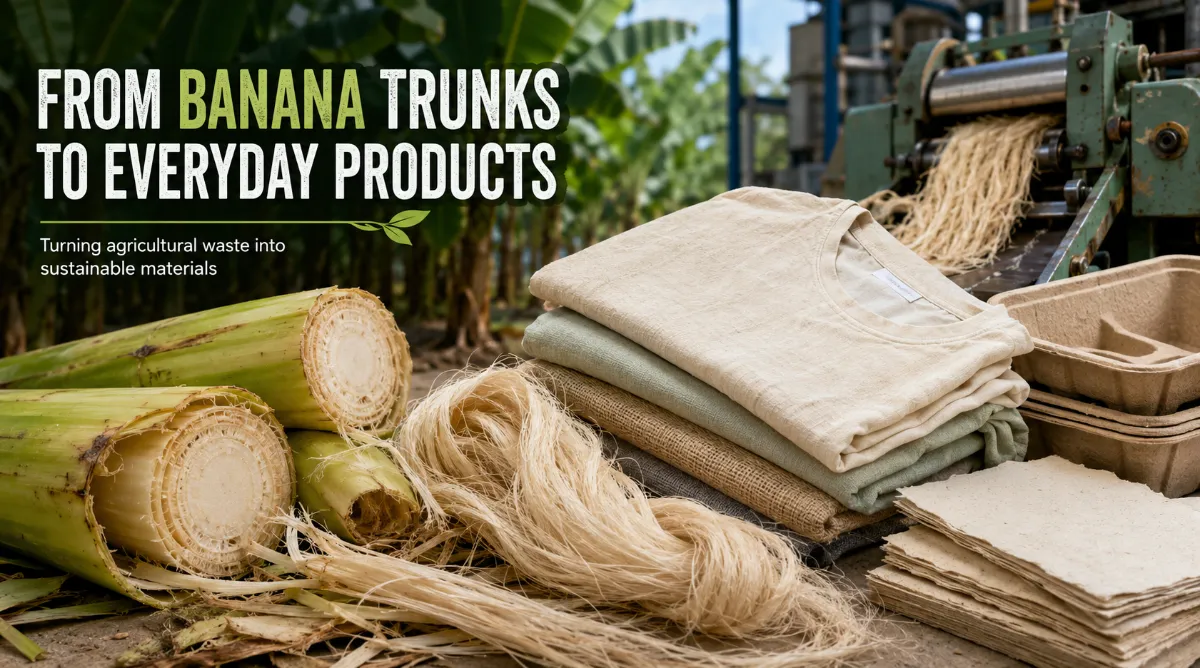
What if the leftovers from your morning banana ended up in your T-shirt, notebook, or even the packaging holding fruit at your local store?
That idea sounds like sustainability marketing, but it is already moving toward industrial reality.
Across banana-producing regions, the massive trunks left behind after harvest — technically called banana pseudostems — are no longer being treated as agricultural waste. Companies and researchers are transforming them into fibers for clothing, paper, packaging materials, and bio-based products, turning what was once discarded biomass into an emerging circular industry.
The hidden mountain of waste inside banana farming
Most people think the banana plant exists only for its fruit. In reality, the edible part is only a fraction of the story.
After harvest, enormous amounts of plant material remain in the field. In some production systems, banana residues can reach around 220 tons per hectare, creating a disposal challenge that has existed for decades. Producer nations generate millions of tons of this biomass annually, and much of it is left to rot, used as compost, or simply burned.
But inside those water-heavy trunks lies something valuable: strong cellulosic fibers.
Researchers have found banana fibers possess mechanical properties that can rival or even surpass traditional natural fibers such as jute and sisal, making them attractive for textiles and composite materials. Studies also suggest banana fiber could become an environmentally friendlier alternative to some cotton applications.
From handmade craft to industrial production
Banana fiber is not new.
Communities in parts of Asia have used banana fibers for centuries in ropes, textiles, and traditional fabrics. What is changing now is scale.
Instead of small artisan production, factories are building organized supply chains around banana waste, introducing quality control, standardized extraction methods, and industrial processing systems. Projects in Brazil have already demonstrated large-scale weaving applications using fabrics made from banana stalk fibers.
The transition matters because sustainability often fails at scale. A material can be environmentally friendly in a workshop but become impractical in industrial manufacturing.
Banana fiber is trying to cross that gap.
Inside the factory: how banana trunks become fabric
The process begins near banana farms.
Transporting fresh pseudostems over long distances is expensive because they are extremely heavy and packed with moisture. Processing facilities therefore tend to stay close to plantations.
The industrial journey usually follows several stages:
1. Sorting and selection
Fresh stems are inspected based on size, moisture content, and condition.
Older or degraded stems generally produce shorter fibers and more impurities, affecting final quality.
2. Mechanical extraction
Factories use a process called decortication.
Machines equipped with rollers and blades scrape and compress the pseudostem, separating the fibrous layer from soft internal pulp. Researchers increasingly view this mechanical route as the most practical large-scale approach because it avoids aggressive chemical processing.
Laboratory testing has shown mechanically extracted banana fibers can achieve tensile strengths around 570 MPa, placing them among the stronger plant-based fibers available for industrial use.
3. Washing and purification
The extracted fibers are washed to remove pulp residues, reduce odor, and improve texture.
This step improves usability but introduces environmental questions because water consumption can become significant. More advanced operations are exploring recycling systems and wastewater treatment to reduce impact.
4. Controlled drying
Drying sounds simple, but it turns out to be one of the most important steps.
Research suggests drying temperature influences physical and mechanical properties, so factories increasingly use controlled air systems and drying chambers rather than relying entirely on sunlight.
After drying, fibers are aligned and prepared for spinning, weaving, paper production, or composite manufacturing.
Banana fiber clothing may be closer than people think
The most visible application is fashion.
Manufacturers are already experimenting with banana-cotton blends, and studies report promising results. Some research found banana-cotton yarns and fabrics performed competitively — and in some cases favorably — compared with pure cotton alternatives.
The material also brings sustainability advantages:
- Uses agricultural waste instead of dedicated crops
- Biodegradable
- Lower dependence on fossil-derived fibers
- Potentially lower environmental impact than some conventional textile pathways
- Creates extra value for farmers from harvest leftovers
For an industry increasingly criticized for waste and synthetic dependence, banana fiber arrives at an interesting moment.
Clothing is only the beginning
The story does not stop at textiles.
Researchers are also testing banana pseudostems for:
- Alternative paper products
- Packaging trays
- Bio-composites
- Molded packaging materials
- Fertilizers
- Compost and biogas production
One study even explored banana-fiber packaging boards as alternatives to recycled paper trays, with encouraging mechanical performance results.
Meanwhile, businesses in countries such as Uganda are already converting banana waste into handicrafts, rugs, lampshades, and other commercial products while creating additional income streams for farmers.
The challenges are still real
Banana fiber is promising, but it is not a miracle material.
Industrialization still faces obstacles:
- Logistics and transportation costs
- Water management during washing
- Farmer training
- Consistent fiber quality
- Scaling supply chains
- Processing remaining pulp waste responsibly
If these problems are not solved, factories risk replacing one waste problem with another.
Still, the idea remains powerful.
For decades, banana trunks were something farmers removed and forgot. Now the same material is being reimagined as fabric, paper, packaging, and industrial feedstock.
The next sustainable textile revolution might not come from a laboratory.
It might already be growing in banana fields.