In most countries, citizens are told their nation is sovereign. In the United States, sovereignty comes with an asterisk.
You can criticize the President. You can mock Congress. You can burn flags in protest and call the Supreme Court outdated. That’s democracy.
But try criticizing Israeli government policy in the same tone.
Watch how quickly the temperature changes.
Suddenly the conversation isn’t about policy. It’s about loyalty tests. About “shared values.” About moral obligations written somewhere between campaign donations and standing ovations.
The United States prides itself on being the world’s loudest defender of free speech. Yet there exists an invisible boundary line — a geopolitical electric fence — that Americans are allowed to approach but never touch.
Step over it, and you’re no longer “critical.” You’re “dangerous.”
The Unbreakable Bond
Washington calls it the “special relationship.”
Special is a polite word. Special means untouchable. Special means automatic. Special means pre-approved funding packages that glide through Congress faster than disaster relief for American citizens.
Presidents come and go. Parties switch colors. Domestic policies swing wildly from one extreme to another.
But one thing remains beautifully stable: billions in military aid, unwavering diplomatic protection, and vetoes at the United Nations that arrive with clockwork precision.
The consistency is admirable.
It’s almost colonial in reverse — a superpower acting like the junior partner in its own foreign policy.
The Wars Nobody Names Directly
Officially, America never goes to war “for Israel.”
It goes to war for democracy.
For stability.
For weapons of mass destruction that may or may not exist.
For counterterrorism.
For regional balance.
But look at the map.
Iraq destabilized.
Syria fractured.
Lebanon pressured.
Gaza inflamed.
And always, hovering in the background, Iran — the final boss of Middle Eastern geopolitics.
Each intervention arrives wrapped in American branding. But the regional scoreboard always seems to align neatly with Israeli strategic interests.
Coincidence is doing heavy lifting.
When the U.S. invaded Iraq, the justification was Saddam Hussein’s imaginary arsenal. The aftermath eliminated one of Israel’s long-standing regional adversaries.
When Syria collapsed into chaos, one more hostile neighbor was weakened.
When Iranian generals are assassinated via drone strike, Washington says it’s about deterrence. Tel Aviv says nothing at all — it doesn’t have to.
The Iran Countdown
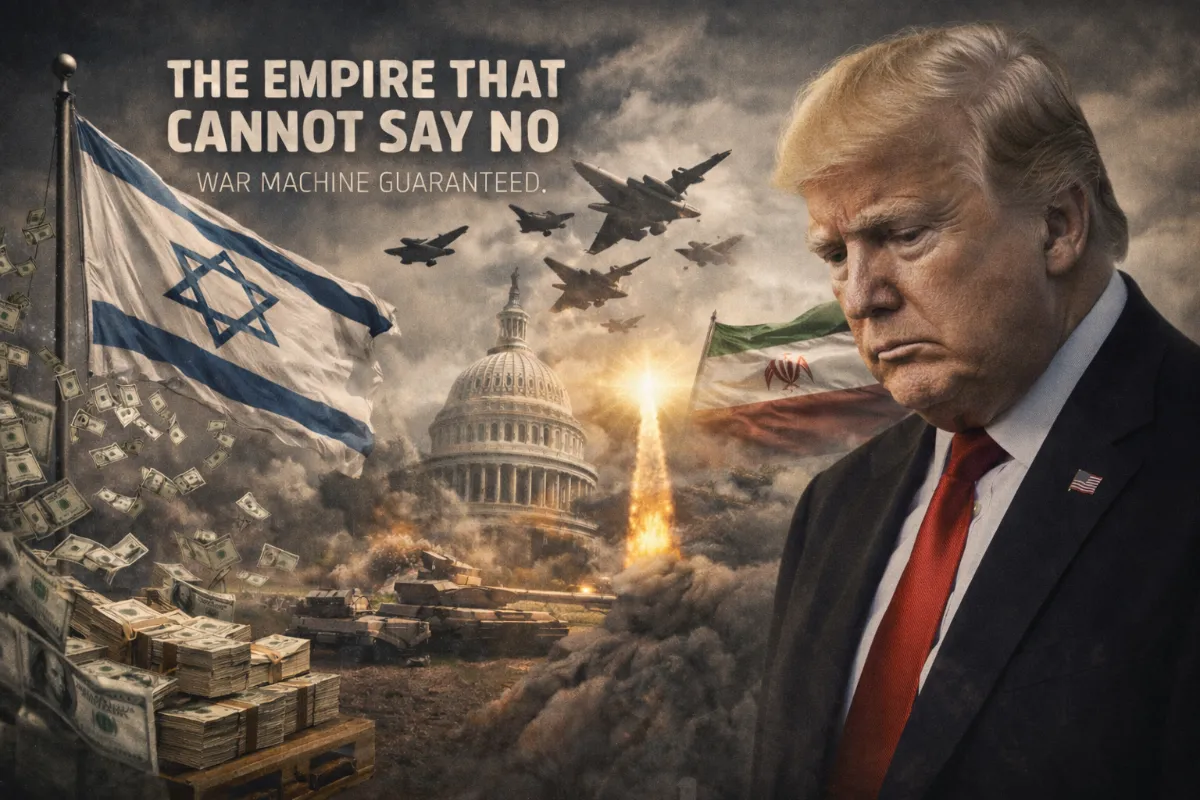
Now comes the next chapter: Iran.
The narrative writes itself. Nuclear threat. Existential danger. Preemptive defense.
If war breaks out, it will not be branded as “for Israel.” It will be about global security, shipping lanes, stability, and the sacred phrase: “We cannot allow this.”
But if missiles start flying, analysts will quietly note who benefits most from Tehran being permanently neutralized.
America will provide the aircraft carriers.
The bombers.
The sanctions.
The headlines.
And Israel will gain a strategic horizon with one less rival.
Again.
Criticism With Conditions
In the United States, you can chant against your own government and be called patriotic.
But criticize Israeli military operations too forcefully, and suddenly your job security becomes fragile.
University presidents stutter. Politicians scramble to reaffirm loyalty. Social media platforms mysteriously moderate more aggressively.
Free speech is sacred — until it collides with the special relationship.
The message is subtle but unmistakable: domestic leaders are fair game. This alliance is not.
The Colony That Isn’t
No official treaty declares the United States subordinate. No Israeli governor resides in Washington.
Yet American policy in the Middle East rarely deviates from one predictable line: protect Israeli security interests at almost any cost.
Trillions spent in the region. Thousands of American lives lost. Entire countries reshaped.
The average American struggles to pay medical bills, but foreign aid packages sail through Congress with bipartisan applause.
It raises an uncomfortable question.
If a nation consistently rearranges its military, diplomatic, and economic priorities around the security of another state — even at massive domestic cost — who exactly is serving whom?
Perhaps “colony” is too dramatic.
Maybe “strategic dependency” sounds better.
Or “permanent alignment.”
Or simply this: a superpower that insists it leads the world, yet seems unable to redraw one specific line in the sand.
The Final Irony
The United States tells the world it spreads freedom.
But in one particular direction, its policy feels pre-written.
Maybe that’s alliance politics.
Maybe that’s lobbying power.
Maybe that’s geopolitical necessity.
Or maybe it’s something more uncomfortable: a global empire that can challenge anyone — except the one ally it dares not disappoint.
And if war with Iran arrives, Americans will once again be told it’s about protecting freedom.
They just won’t be told whose freedom is being prioritized.