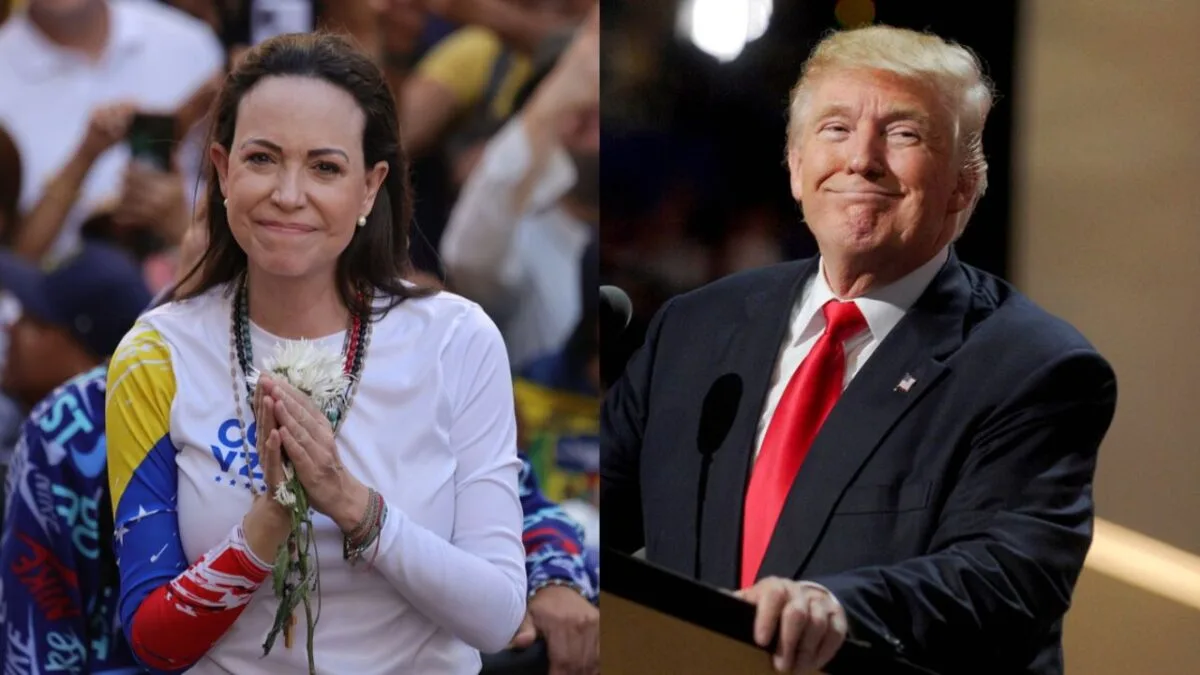
When the 2025 Nobel Peace Prize was announced, few were surprised by the name that emerged from Oslo: María Corina Machado, the Venezuelan opposition leader who became a symbol of resistance against Nicolás Maduro’s regime.
But what came next caught the world off guard.
Within hours of the announcement, Machado called Donald Trump — and, in a strikingly personal gesture, dedicated her Nobel Prize to him.
A Call That Echoed Beyond Politics
For many observers, the call was more than a polite courtesy. It was a political message wrapped in gratitude, a calculated echo across two continents.
According to multiple reports, Machado told Trump that she accepted the prize “in his honor,” thanking him for his “decisive support” during her years of struggle for democracy in Venezuela.
Trump later confirmed the exchange, saying,
“She called me and said, ‘You really deserved it.’ She accepted the prize in my honor.”
In an era when every word is parsed for subtext, Machado’s gesture seemed to bridge personal conviction and political strategy — a rare mix of sincerity and symbolism.
Trump’s Role in Venezuela’s Democratic Struggle
To understand the meaning behind the call, one must revisit Trump’s own relationship with Venezuela.
During his presidency, Trump became one of the loudest international critics of Maduro, imposing sanctions, recognizing opposition leader Juan Guaidó as interim president, and pledging unwavering support for democratic reform.
For Machado, who risked imprisonment and exile for her activism, that support wasn’t just policy — it was personal. Trump’s stance gave her movement legitimacy and global attention at a time when international focus on Venezuela was fading.
By dedicating her Nobel Prize to him, Machado was — in a way — closing a political loop that began years ago.
Between Gratitude and Strategy
Of course, critics were quick to question her motives.
Was the call to Trump a genuine act of appreciation, or a strategic alignment with the populist right that could deepen divisions back home?
For many Venezuelans, especially those wary of U.S. interference, the dedication stirred discomfort. Some saw it as an unnecessary provocation; others, as a calculated play to keep Washington’s attention on Venezuela’s crisis.
Yet, there’s another layer here — one that feels almost human.
For someone who has endured repression, isolation, and vilification, calling the one global leader who publicly stood by her might not be strategy at all.
It might simply be gratitude.
The Nobel Committee’s Controversial Choice
The Nobel Committee’s decision to honor Machado wasn’t without controversy either.
The award, traditionally given to peacemakers and diplomats, went this year to a woman whose struggle is explicitly political — and whose movement is still fighting an ongoing battle, not celebrating its end.
The White House reacted frostily. An official statement criticized the Nobel Committee for “politicizing peace,” suggesting that honoring Machado while overlooking other nominees reflected “partisan priorities.”
The irony wasn’t lost on anyone: a Nobel meant to symbolize neutrality had once again become a mirror of global divisions.
Trump’s Redemption Through Reflection
For Trump, the call may have offered something else — a rare moment of moral vindication.
After years of public ridicule for his own Nobel ambitions, here was a laureate saying, in essence, you deserved this too.
In the theater of politics, that is more than flattery; it is narrative repair.
It recasts Trump, at least momentarily, as a figure of global consequence beyond America’s borders.
And for Machado, aligning herself with a U.S. president still adored by millions worldwide helps keep Venezuela’s story alive — and her own name in the headlines.
A Symbolic Gesture in a Cynical Age
Whether one views Machado’s call as an act of courage, gratitude, or opportunism depends largely on where one stands politically.
But stripped of its noise, the gesture carries something rare in today’s politics: symbolism that still feels personal.
A woman who fought for freedom in one of the world’s most repressive regimes reached across oceans to thank a man whose policies once gave her hope.
That’s not about diplomacy. That’s about memory.
In the end, Machado’s call wasn’t just to Donald Trump — it was to the world.
A reminder that in the messy geometry of global politics, gratitude can still sound like rebellion, and peace can still be political.